

March 12, 2026 ⏱️ 12 min
By Cristi C. (RnD – WebFrontend Group)
Software development is a constantly evolving field that strives to meet market demands. In today’s landscape, scalability and the ability to ship fast, atomic updates are critical, as users expect quick fixes and zero downtime.
A solid architecture is essential; but, as in life, there is no “silver bullet” or one-size-fits-all solution in software engineering. Engineers must understand the trade-offs and choose the right tools for the problem.
Scaling may sound simple… until you’re the one who has to do it.
Composable Frontends
Microservices is a term/architecture widely used with a lot of developers praising the benefits no matter the requirements.
Composable Frontends are the frontend equivalent of Microservices, an architectural approach where a web application is built by assembling independent, decoupled, and reusable UI components that can be developed, deployed, and scaled autonomously.
If we were to compare it to the “Monolithic” architecture where the UI is one large, interconnected block, “Composable Frontends” treat the UI like a collection or self-contained miniature application.
While powerful, it comes bundled with a new set of concerns:
- Autonomy – each component can be owned by a specific team and have its own lifecycle, meaning deployments can be decoupled.
- Orchestration – we need a new layer (a shell or container) that acts as the host, pulling these scattered pieces together at runtime or build-time to present a unified experience to the user.
- Interoperability – components need to communicate through standardized contracts (such as custom events or shared state) rather than being hard-coded into one another.
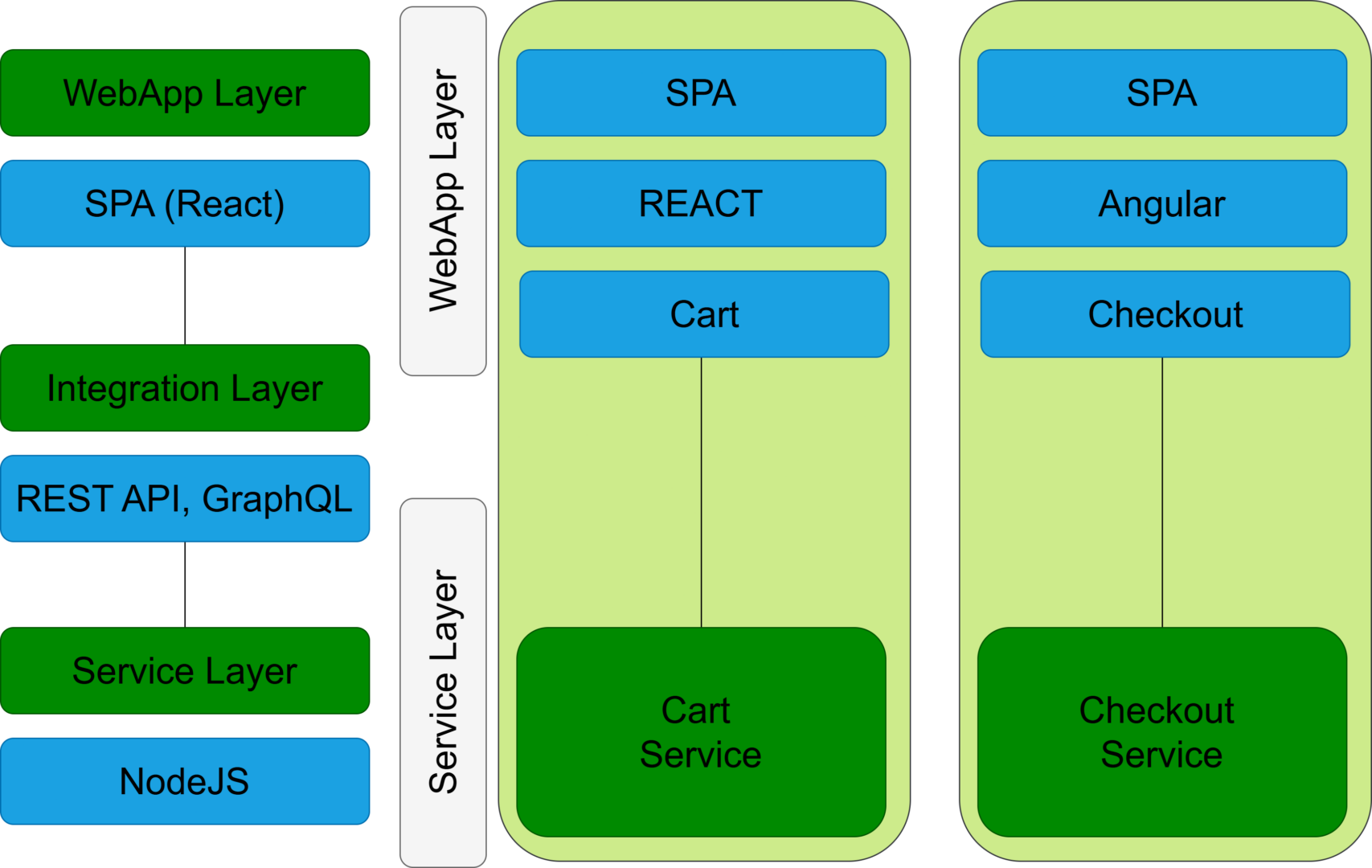
Why would you consider such a system?
The primary driver for adopting a composable architecture is the inherent friction and scaling limitations of a monolithic frontend, especially as the application or the teams working on it grows.
But this is just the tip of the iceberg and there are other problems that are far more insidious:
- Deployment Risk – a small change in one part of the application requires redeploying the entire application, creating a risk.
- Slow Development Cycles – large codebases become harder to navigate, test, and manage. This is amplified when multiple teams are involved, as they can frequently block each other during code reviews or deployments.
- Technology Lock-in – once you choose a framework (e.g., React, Angular, Vue) for your monolith, you’re largely stuck with it. Making changes is becoming a monumental task.
- Scaling Challenges – as the team grows, maintaining code quality and consistency in a single repository becomes a significant overhead.
- Cognitive Load – developers need to understand large swathes of the codebase, even if they’re only working on a small feature.
Why Go Composable
A composable frontend isn’t just about breaking things apart; it’s about how those pieces are structured, how they communicate, and how they are ultimately presented as a unified experience.
The layers
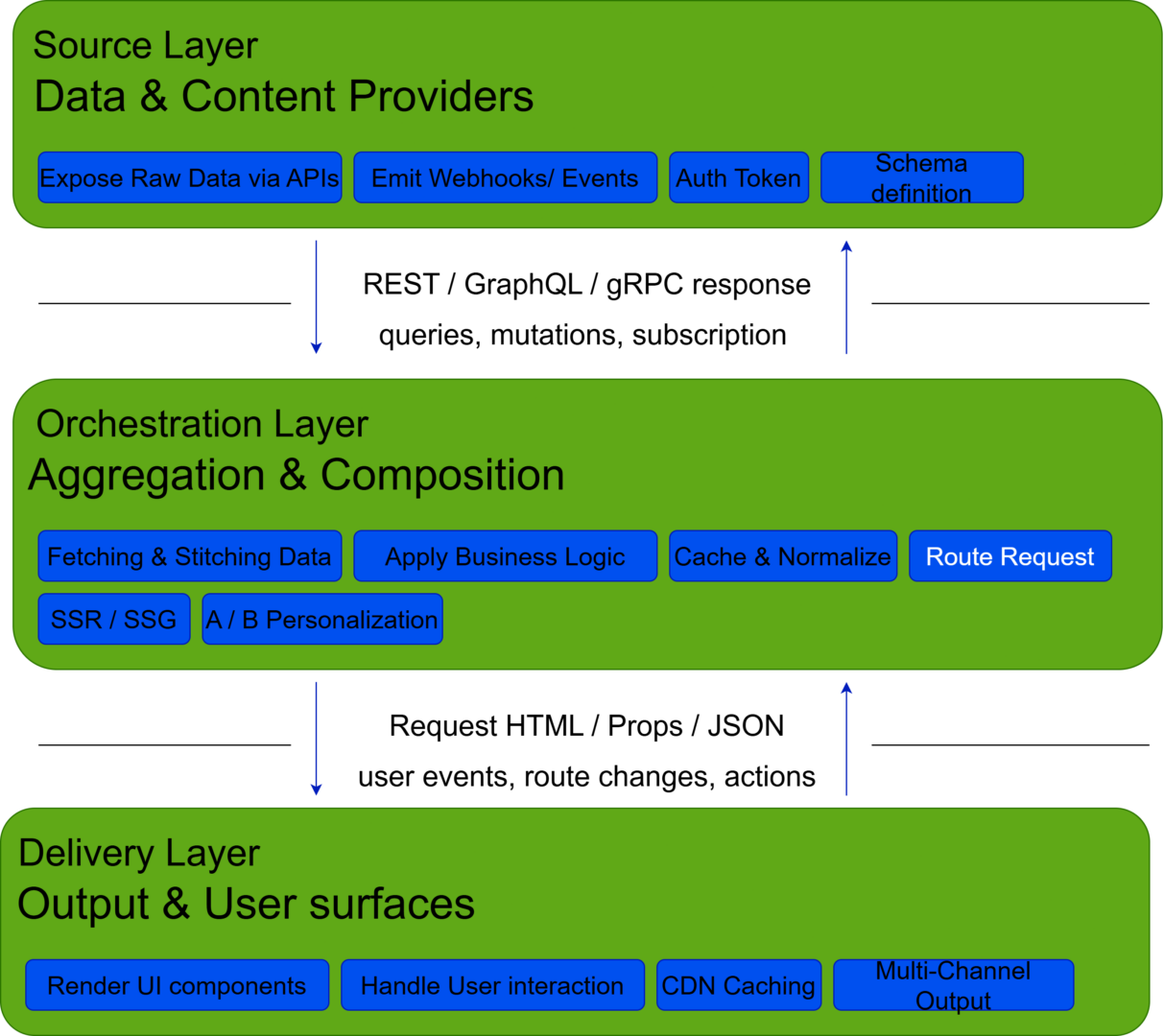
Thinking about architecture in layers is often the simplest way to understand it. In our case, a composable system can be thought of as having three distinct layers that work together in concert:
- Source Layer – this is where your individual UI components (Micro Frontends) and their underlying data sources live. These are autonomous “business capabilities”.
- Orchestration Layer – this is the “glue” that holds everything together. It’s responsible for fetching the necessary UI components and data, stitching them together, and often deciding which version of a component to display (e.g., for A/B testing). This can happen on client-side, server-side (at the edge), or at build-time.
- Delivery Layer – this is the user’s browser, which receives the fully assembled and rendered experience.
Communication using Standardized JSON schemas
For independent modules to interact reliably, they need clear, versioned contracts. This is where Standardized JSON Schemas become critical. Instead of relying on implicit agreements or tightly coupled code, modules define exactly what data they expect and what data they provide. This is known as a schema-first design.
This approach ensures interoperability regardless of the underlying technology stack of each micro-frontend or data service.
For example, a “Product Card” component might expect data to conform to a specific ProductSchema.json. It doesn’t matter if that data comes from a legacy database, a new microservice, or a third-party API, if the schema is respected.
Late binding
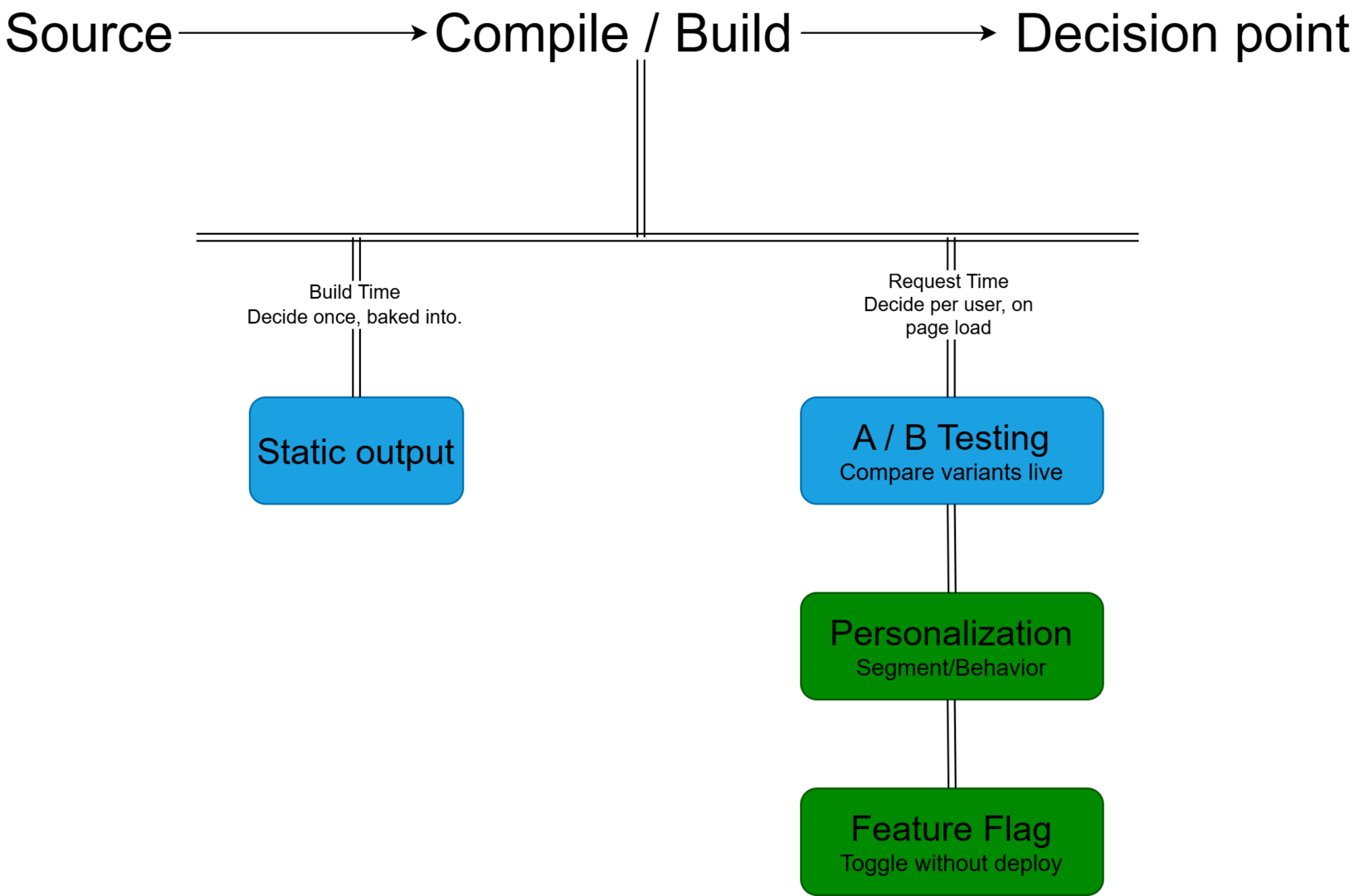
One of the most powerful aspects of composable frontends is “late binding” or the capability to decide which version of a feature to show at request time rather than build time.
This capability is fundamental for:
- A/B Testing – easily test two different versions of a button or a widget to see which performs better.
- Personalization – show different content or layouts based on user segments, location, or past behavior.
- Feature Flags – roll out new features gradually to a subset of users or toggle them on/off instantly without a full deployment.
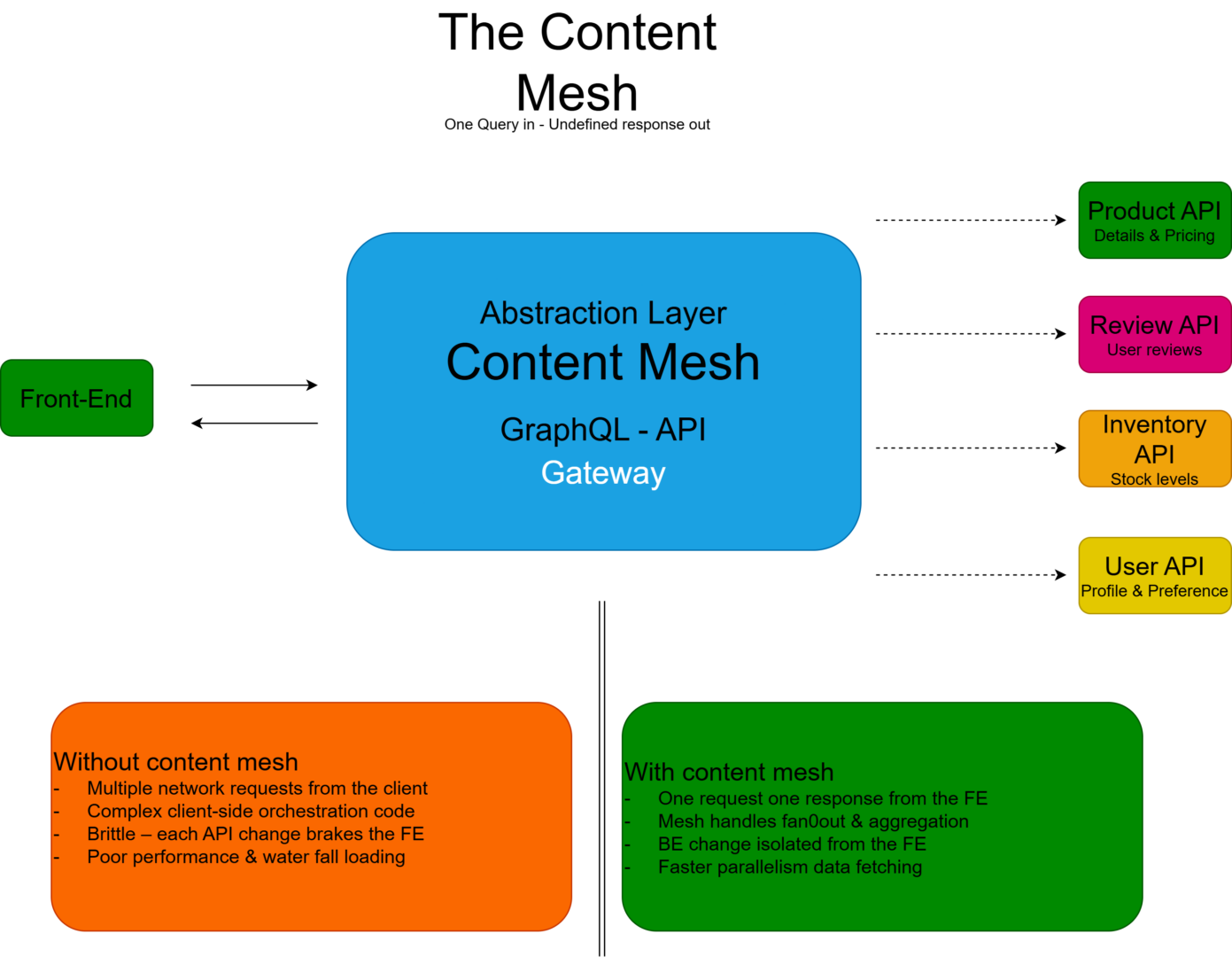
Puling data from multiple sources (GraphQL or unified APIs)
In a composable architecture, your UI often needs to pull data from many different, independent services (e.g., product details from one API, user reviews from another, stock levels from a third). Directly calling each of these from the frontend leads to complex client-side code, performance issues (multiple network requests), and brittle integrations.
The Content Mesh solves this. It’s an abstraction layer— often implemented with GraphQL or a similar unified API gateway— that sits between your frontend and its many data sources. The frontend makes a single, expressive query to the Content Mesh, and the mesh is responsible for fanning those requests to the various backend services, aggregating the results, and returning a unified response.
Adoption Costs
While the benefits are compelling, composable frontends introduce their own set of complexities. This architecture is an investment, and the costs must be carefully weighed. The cost isn’t just financial (although most things translate to ROI) but also includes morale costs that affect the team.
For a young or inexperienced team, the added complexity can lead to a poor developer experience: engineers may produce subpar code, or, over time, leave due to stress. So just because we can build it doesn’t mean we should!
Looking more closely at the costs, we can identify several “areas” that may be affected:
1. Team (Cognitive Load & Collaboration Overhead):
- Increased Complexity – teams must now manage multiple repositories, deployment pipelines, and versioning strategies.
- Cross-Team Communication – in a multi-team setup, individual teams may be autonomous, but they still need to coordinate shared components, APIs, and design systems.
- Developer Experience (DX) – setting up a local development environment for a composable system, which may involve running multiple micro-frontends and services, can be significantly more complex than for a monolith.
2. Performance (Bundle Size & Network Requests):
- Payload Tax – if not managed carefully, each micro-frontend can bring its own version of a framework (e.g., multiple React runtimes), leading to bloated bundle sizes and slow load times.
- Orchestration Overhead – the process of stitching components together, especially client-side, can introduce latency.
- Increased Network Calls – more independent services can mean more HTTP requests unless mitigated by a Content Mesh or server-side rendering.
3. Management (Governance & Monitoring):
- Version Management – ensuring compatibility between different versions of micro-frontends and their underlying schemas is critical and can be challenging.
- Centralized Monitoring – tracking user journeys across multiple, independent deployed services requires robust distributed tracing and logging.
- Consistency – maintaining a consistent user experience (design, accessibility) across independently developed components demands a strong design system and governance.
4. Cash (Infrastructure & Tooling):
- Higher Infrastructure Costs – running more services (even if smaller) can increase cloud hosting costs.
- Tooling Investment – requires investment in advanced deployment pipelines, CI/CD, feature flag management, monitoring tools, and possibly GraphQL servers.
- Initial Setup Cost – the initial architectural setup and team training represent a significant upfront investment.
What kills adoption?
So far, we’ve seen that while there are potentials downsides, the benefits of composable frontends are significant. But this raises a question: Why is this still a niche architecture approach?
Well, there are several factors that can lead to the failure or abandonment of a composable frontend initiative:
- Premature Optimization – adopting this complex architecture for a small, simple application where a monolith would suffice: Is this really what the project needs?
- Lack of Governance – without a shared design system, clear communication protocols, and schema enforcement, the UI quickly becomes fragmented and inconsistent: Who is responsible for this?
- Ignoring Performance – failing to address the “payload tax” and orchestration overhead can lead to a slow, frustrating user experience.
- The bill – not accounting for the increased operational burden on DevOps, QA, and developers. Remember the first time you saw the Azure bill?
- Poor Communication – teams operating in silos without adequate cross-functional collaboration, leading to delays, misalignments, and inconsistent outputs.
Micro vs Composable
The terms Composable Frontends and Micro Frontends are often used interchangeably, leading to significant confusion. While deeply related, they represent distinct concepts.
Micro Frontends is an architectural style in which an application’s UI is composed of features that can be developed and deployed independently while Composable Frontends is an architectural approach where a web application is built by assembling independent, decoupled, and reusable UI components.
| Feature | Micro Frontends | Composable Frontends |
|---|---|---|
| Primary Focus | Team Autonomy & Independent Deployment | Business Capability & Dynamic Assembly |
| Core Problem | Organizational scaling, slow releases, tech lock-in | Flexibility, personalization, rapid feature iteration, data unification |
| Granularity | Often larger, self-contained features/sections | Can be smaller components (widgets, data points) or full features |
| Mechanism | Runtime integration (e.g., Module Federation, Single-SPA) | Orchestration of any independently deployable UI units (can include Micro Frontends) |
| Relationship | A mechanism or tool to achieve composability | The overarching architectural strategy for building UIs from parts |
You can have a Composable Frontend system that uses Micro Frontends as one of its primary building blocks. But you can also have a Composable Frontend that achieves modularity through other means (like server-side includes or highly modular component libraries) without strictly adhering to the Micro Frontend architectural style.
Micro vs Composable
The decision to adopt a “Composable frontends” architecture is strategic and depends heavily on your organization’s scale, team structure, and business goals. Typical scenarios include:
- Large, Growing Organizations – if you have multiple, large, or geographically distributed teams working on a single frontend, and deployment bottlenecks are common.
- High Demand for Agility – if your business requires rapid iteration, frequent A/B testing, and personalized user experiences.
- Complex User Journeys – if your application spans many distinct business domains (e.g., e-commerce, content, CRM, internal tools).
- Legacy Modernization – if you need to incrementally update an aging monolithic frontend without a “big bang” rewrite.
- Independent Product Domains – if you have distinct product lines or business units that could benefit from owning their entire slice of the customer experience.
If your application is small, managed by a single cohesive team, and has infrequent deployment needs, the added overhead of composability might not be worth the investment.
Conclusion
Another tool in the toolbox?
Composable Frontends are undoubtedly a powerful addition to the modern software engineer’s arsenal. They offer unparalleled agility, scalability, and resilience for complex, evolving web applications. They are not a silver bullet; they are a sophisticated tool designed for specific, challenging problems and are often unnecessary for simpler applications.
What are we building?
The core question remains: What are we building? For simple, small-to-medium applications, the traditional monolith, with a robust component library, often remains the most efficient choice.
For large-scale enterprises with multiple product lines, distributed teams, and high demands for continuous innovation and personalized experiences, composability offers a transformative path forward.
Quality always matters
Ultimately, the principles behind Composable Frontends — modularity, clear interfaces and independent deployments — are valuable regardless of the architecture. Even within a monolith, striving for well-encapsulated components, clear data contracts, and logical separation of concerns will make your system more flexible, maintainable, and adaptable to future change.
The future of frontend development is about managing complexity and maximizing developer velocity. Composable Frontends provide a robust blueprint for achieving exactly that.
Îndemnul nostru
Efortul pus în programele pentru studenți completează teoria din facultate cu practica care “ne omoară”. Profitați de ocazie, participând la cât mai multe evenimente!
În cei 3 ani am lucrat la proiecte diverse ce au contribuit decisiv la evoluția mea profesională. Am colaborat strâns cu echipe remarcabile, a căror dedicare și sprijin au fost fundamentale în buna dezvoltare a lucrurilor. Cu fiecare proiect, am învățat nu doar aspecte tehnice, ci și abilități esențiale de comunicare și colaborare, reflectate în experiența mea privind interacțiunile cu clienți și modul în care o echipă eficientă operează. Aceasta este cultura companiei, de la ritmul uneori alert al zilei de lucru și practicile Agile, până la momentele relaxante de socializare cu colegii în pauzele de cafea și activități recreative precum darts și ping pong.

Am făcut cunoștință cu echipa NetRom prin intermediul programelor Internship și NetRom Software Academy, in care am descoperit că noțiunile învățate acasă au totuși aplicabilitate, chiar în cadrul unor aplicații reale. Acele experentie m-au convins să aplic pentru un job.
Mentorii foarte deschiși și colegii cu experiență care mi-au răspuns prompt la toate neclaritățile au transformat provocările în task-uri rezolvate cu succes împreună. Făcând parte din #teamnetrom mi-am depășit frica de a greși și am evoluat într-un mod echilibrat pentru mine.

Am aflat de programele NetRom de la o prezentare organizată în facultate de companie. Am decis să mă înscriu la Summer Camp din dorința de a înțelege ce anume ar presupune o cariera în IT. În urma acestui stagiu de practică, am reușit să dezvolt propria aplicație cu ajutorul mentorilor care mi-au oferit informații teoretice, dar mai ales practice, pe care nu aș fi putut sa le găsesc într-un tutorial aleatoriu de pe internet. Modul meu de abordare a aplicaților s-a schimbat odată ce am înțeles în ce constă mai exact procesul, ce presupune un mediu real de lucru și importanța muncii în echipă.

NetRom Software Testing Academy a fost punctul de plecare pentru o carieră pentru mine. Pe parcursul sesiunilor am avut oportunitatea să cunosc bazele necesare pentru asigurarea calității unui produs, urmate de o zi în companie unde am văzut teoria pusă în practică.
Recomand tuturor celor care își doresc o carieră în QA să ia în considerare această academie, fiind destinată atât celor din domeniu, dar nu numai.

Am descoperit NetRom prin intermediul unui program de internship și am fost impresionată încă de la început de mediul de lucru plăcut, de susținerea și angajamentul colegilor. A fost o oportunitate deosebită de a lucra într-o echipă de proiect, cu roluri specifice, și de a înțelege mai bine cultura companiei. Întreaga perioadă s-a dovedit o experiență valoroasă, atât din punct de vedere al cunoștințelor acumulate, cât și prin prisma relațiilor dezvoltate. În momentul în care mi s-a propus să continui ca angajat permanent, a fost o decizie ușor de luat, bucuroasă fiind să pot aplica cele învățate, dar și să adaug cunoștințe noi în fiecare zi.
