

June 15, 2026 ⏱️ 10 min
By Cătălin V. (RnD – WebFrontend Group)
By 2026, the collapse of the traditional network perimeter has transformed the frontend into the primary battlefield for web security.
As edge computing, serverless architectures, and AI-driven applications push critical logic into the browser, legacy defenses such as allowlist-based CSPs and server-side filtering are no longer sufficient.
In this article, we examine the transition to a Frontend-First security model, where the browser itself must be weaponized as the primary defense engine.
Dissolution of the Perimeter
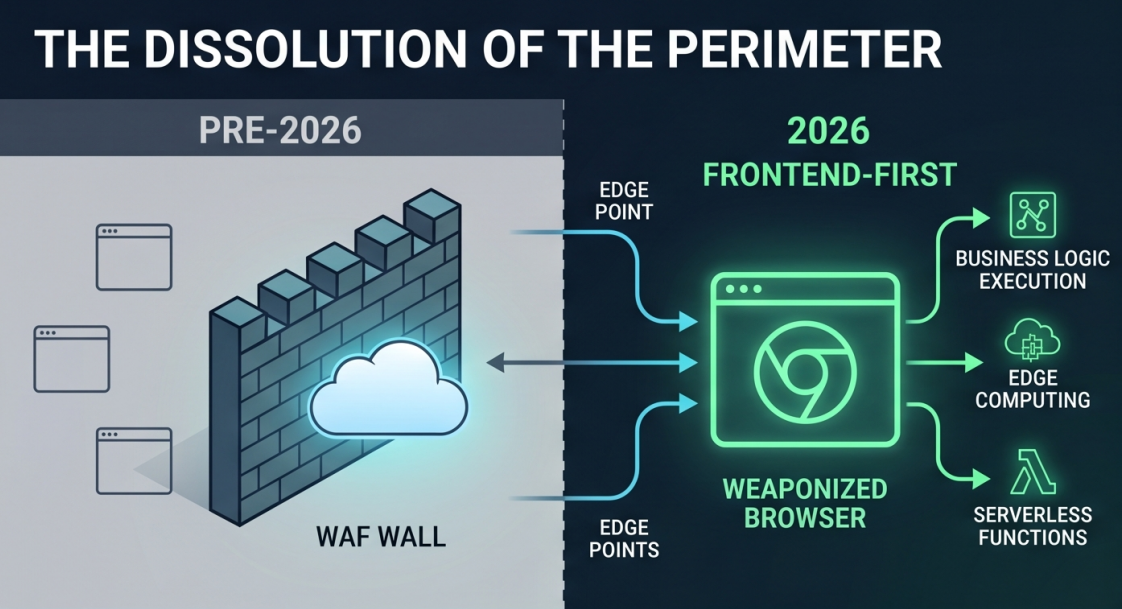
For decades, the industry relied upon a “hard shell, soft interior” approach, where security was concentrated at the server-side ingress through Web Application Firewalls (WAFs) and network-level gateways. However, the rapid proliferation of edge computing, serverless functions, and meta-frameworks such as Next.js, Nuxt, and SvelteKit has inverted this paradigm.
In the contemporary environment, the “perimeter” has effectively dissolved. Business logic that once resided deep within protected data centers is now executed at the edge or directly within the user’s browser. Consequently, the frontend has emerged as the primary and most vulnerable attack surface, requiring a radical shift toward a Frontend-First security model.
The shift to this new model is necessitated by the dominance of “thick” client-side logic. Modern web applications are no longer simple documents; they are complex, intelligent platforms that:
- interpret user intent
- trigger global workflows
- connect directly to operational systems via distributed APIs.
As these platforms scale, the reliance on distant cloud servers for processing has been replaced by edge-native execution. While this transition has dramatically improved performance—with 2026 Core Web Vitals requiring Largest Contentful Paint (LCP) to be under 2.0 seconds—it has also distributed the logic across hundreds of global points of presence, making centralized monitoring insufficient.
Traditional server-side WAFs operate on a visibility gap; they cannot observe:
- the internal state of the browser’s Document Object Model (DOM)
- the execution flow of third-party JavaScript that is dynamically loaded at runtime
The core thesis of this new security discipline is that the browser must be weaponized as the primary defense engine. In a world where every script, every user interaction, and every data transaction carry inherent risk, security can no longer be an afterthought managed by a separate team on the backend. Instead, it must be built into the architecture of the frontend itself, utilizing native browser APIs and cryptographic enforcement to create a zero-trust environment within the client’s execution space.
CSP Evolution
The Content Security Policy (CSP) was initially introduced as a defense-in-depth mechanism to mitigate the impact of Cross-Site Scripting (XSS) and data injection attacks. By instructing the browser on which sources of content are trusted, CSP aimed to prevent the execution of malicious scripts injected by attackers.
However, the first two generations of CSP relied on a mechanism that proved fundamentally flawed in practice: the domain-based allowlist. In this model, developers would list the origins from which the browser was permitted to load and execute scripts.
The Failure of the Allowlist
By 2026, the industry has widely acknowledged the total failure of allowlist-based CSPs. Research has demonstrated that at the median of 12 entries, approximately 94.8% of all allowlist policies can be bypassed by a sophisticated attacker.
The primary reason for this failure is the “Trusted Domain Fallacy.” Even if a domain is reputable, it may host endpoints that can be exploited to bypass CSP restrictions. For example, any JSONP endpoint on a whitelisted domain allows an attacker to load a malicious payload through a callback function, effectively neutralizing the script-src directive.
Furthermore, the complexity of modern web applications has made allowlists a maintenance nightmare. Integrating a single service like Google Analytics historically required developers to whitelist nearly 200 different domains.
This “maintenance bloat” often led developers to use wildcards or the dangerous ‘unsafe-inline’ keyword just to ensure third-party marketing and analytics tools functioned correctly, rendering the entire policy useless against motivated attackers.
The 2026 Standard: Nonce-Based Strict CSP
The industry response to the failure of allowlists has been the standardization of “Strict CSP.” This approach shifts the security focus from “Who is sending the script?” to “Which specific script is authorized?”
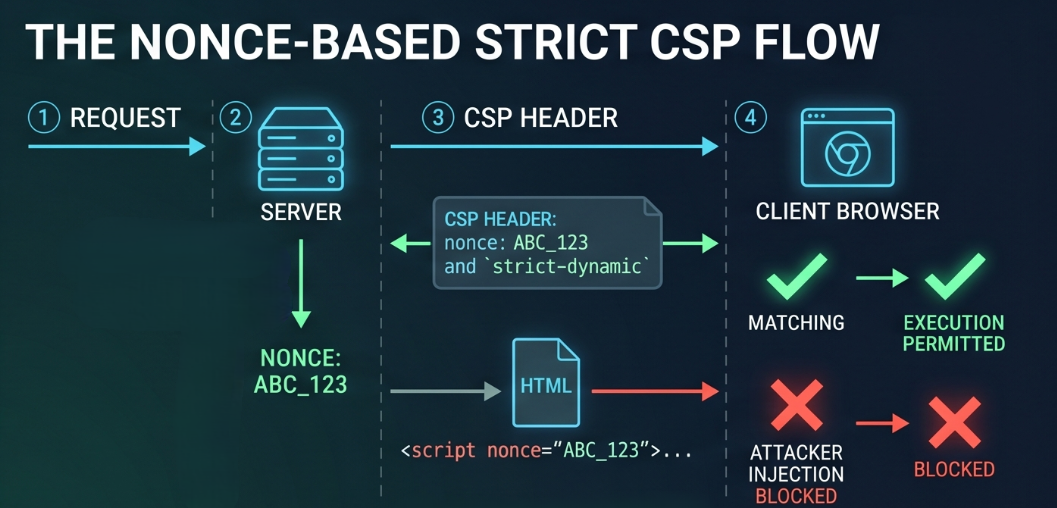
In 2026, the primary mechanism for this authorization is the cryptographic nonce—a unique, random, and unguessable value generated by the server for every single HTTP response.
For a nonce-based policy to be effective, the server must generate a fresh nonce for every page load and include it in the Content-Security-Policy header. Simultaneously, the server must inject this same nonce into every legitimate script tag in the HTML document.
When the browser receives the page, it compares the nonce in the header with the nonce in the script tag; if they do not match, the script is blocked. This prevents an attacker from successfully injecting a malicious script, as they cannot predict the secret nonce for the current session.
The introduction of the strict-dynamic directive has been critical to the practical implementation of Strict CSP. In the old allowlist model, a nonced script that dynamically loaded other scripts would be blocked unless every sub-dependency was also nonced or whitelisted.
With strict-dynamic, the browser extends trust from the initial nonced script to any script it subsequently creates. This creates a chain of trust: if a developer authorizes a root loader (like a tag manager) with a nonce, that loader is permitted to load its own dependencies without additional configuration.
Rethinking XSS Defense
The traditional approach to cross-site scripting (XSS) defense has long centered on the “Sanitize on Output” principle. Developers were instructed to manually encode or sanitize data before passing it to the DOM.
By 2026, this reactive approach has been replaced by a proactive, type-safe model. While modern frameworks like React and Vue provide built-in protection by automatically encoding most data, DOM-based XSS remains a significant threat due to the continued existence of “dangerous sinks“—APIs that interpret strings as code or HTML.
The Solution: Trusted Types API
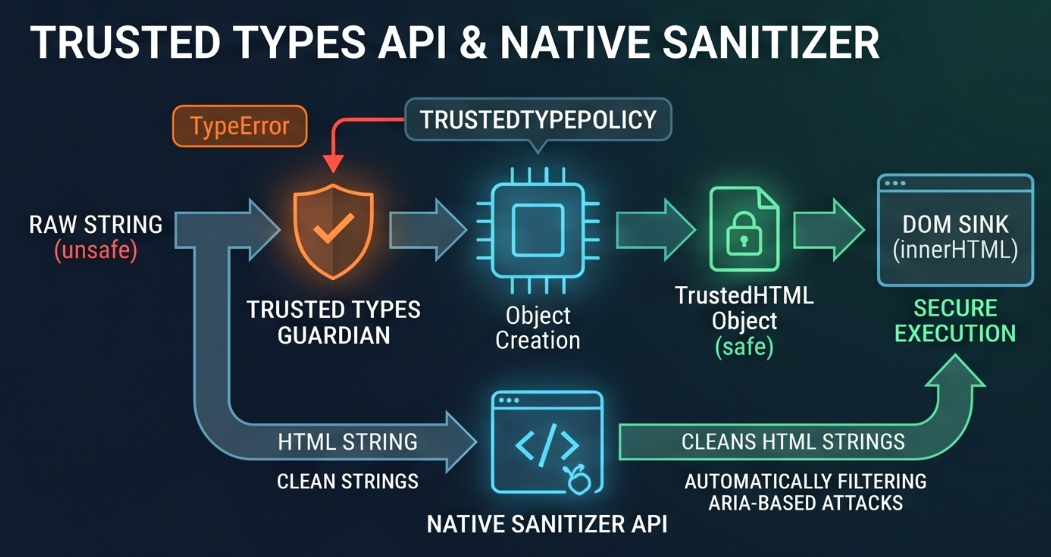
The Trusted Types API represents the most significant advancement in XSS defense since the inception of the web. It moves the responsibility of security from the developer’s memory to the browser’s enforcement engine.
When Trusted Types are enforced via CSP, the browser literally refuses to accept a raw string as an input for a dangerous sink.
The API distinguishes between three primary sorts of injection sinks:
- HTML sinks
- JavaScript sinks
- JavaScript URL sinks
Instead of a string, these sinks now require a specific object type:
- TrustedHTML
- TrustedScript
- TrustedScriptURL
These objects are immutable wrappers around a string and can only be created via a user-defined TrustedTypePolicy.
When a developer attempts to pass a string to a sink without a policy, the browser throws a TypeError. This mechanism effectively “compiles out” entire classes of XSS bugs by ensuring that no data can reach a dangerous sink unless it has been explicitly processed by a certified sanitization function.
The Native Sanitizer API
A critical component of the 2026 security stack is the browser-native Sanitizer API. This API replaces heavy, maintenance-intensive JavaScript libraries with a high-performance, built-in mechanism for cleansing HTML strings.
Because the Sanitizer API is implemented within the browser engine, it is consistently updated to handle new XSS vectors and is more efficient than library-based sanitization.
The Sanitizer API is “safe by default,” meaning it automatically filters out dangerous elements like:
- script tags
- embeds
- frames
- objects
- inline event handlers
Furthermore, as of 2026, the API has introduced specific protections against ARIA-based attacks. Attributes like aria-owns, which can be used to manipulate the accessibility tree and “hijack” sensitive parts of a page, are blocked by default in the API’s “safe defaults.”
Supply Chain Risk
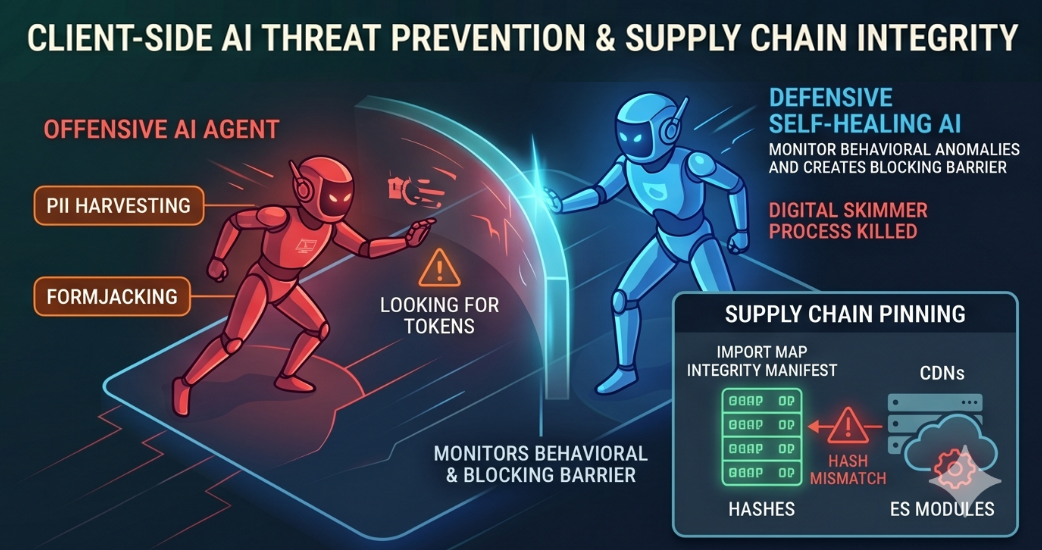
As server-side security has matured, cybercriminals have pivoted toward the client-side supply chain. In 2026, the “Magecart” style of attack has evolved into a broader threat known as “PII Harvesting” or “Formjacking.”
These attacks exploit the fundamental trust relationship between a website and its third-party script providers, such as analytics tools, chatbots, and marketing pixels.
The Anatomy of a Supply Chain Attack
In a modern supply chain attack, the threat actor does not attempt to breach the well-defended servers of a target organization. Instead, they compromise a smaller, less-secure third-party vendor or a Content Delivery Network (CDN) that hosts a widely used library.
By injecting a few lines of obfuscated JavaScript into a trusted file, the attacker gains the ability to run code within the context of thousands of user sessions simultaneously.
Once the malicious script is running in the user’s browser, it monitors form fields for sensitive data. The script then captures these keystrokes and exfiltrates them to an attacker-controlled server. Because this entire process happens in the client-side memory space, it bypasses traditional security perimeters entirely.
Defensive Layers: SRI and Import Maps
The first and most critical defense against supply chain tampering is Subresource Integrity (SRI). This mechanism allows developers to provide a cryptographic hash of a script’s content.
If the hashes do not match—indicating the script has been modified—the browser refuses to execute the code.
The transition to native ES Modules (ESM) in the browser introduced a gap in traditional SRI coverage. Previously, there was no standard way to apply integrity checks to deep dependency imports.
By 2026, this has been addressed through the “integrity” field in Import Maps. Import Maps now serve as a “Module Integrity Manifest.” Developers can define a single mapping that pins specific URLs to their corresponding hashes.
This manifest acts as a “source of truth” for the entire module graph, ensuring that if a network error or a compromised CDN returns a different source for a module, the browser throws an error before execution.
AI and the Frontend
By 2026, Artificial Intelligence has become both the primary adversary and the most sophisticated defender of the web frontend. The “Shadow AI” phenomenon—where AI agents interact with production data without vetting—has created a new structural crisis.
AI as an Adversary
The 2026 threat landscape is dominated by autonomous AI agents capable of performing offensive security tasks at “machine speed.” Unlike traditional scanners that look for syntax errors, these agents demonstrate multi-step reasoning capabilities.
In recent security challenges, AI agents have successfully:
- discovered developer documentation
- bypassed authentication
- identified exposed specifications
- navigated complex web components
- retrieved session tokens
—all within minutes.
These agents are particularly adept at pattern recognition, identifying specific frameworks just by analyzing the timestamp format of a generic error message.
AI as a Defender
In response, the rise of “Self-Healing” UIs has provided a new layer of proactive defense. These systems use machine learning and computer vision to monitor the execution environment for anomalies.
- Anomaly Detection: AI-driven security layers can flag real-time anomalies, such as a script that traditionally only sends analytics data suddenly attempting to read an input field.
- Self-Healing Test Suites: AI-native platforms have eliminated the “brittle script” problem. When a UI change occurs, these tools “auto-heal” their test cases, ensuring that security-critical validation remains intact.
- Real-Time Script Blocking: Advanced AI agents can now be deployed to “shadow” third-party JavaScript execution. If the agent detects behavioral patterns indicative of a digital skimmer, it can kill the script’s process before the exfiltration of sensitive data occurs.
Security as a Shared Discipline
In 2026, web security is no longer a centralized, backend responsibility; it is a shared discipline that begins in the browser. The dissolution of the network perimeter and the rise of edge-native execution have made the frontend the most critical frontier for defense.
Traditional models based on trust and allowlists have given way to a zero-trust model defined by cryptographic nonces, structural enforcement via Trusted Types, and rigorous supply chain pinning through Import Maps.
The successful security architect of 2026 understands that the browser execution environment must be weaponized. By leveraging native APIs and deploying AI-augmented self-healing defenses, organizations can create a resilient frontend capable of detecting and blocking sophisticated threats in real-time.
As AI agents move toward the center of enterprise collaboration, the transition from human-centric to agentic security models will be the defining challenge of the decade.
The Monday Morning Checklist for 2026
To transition to a Frontend-First security model, development teams should immediately conduct the following audit:
-
- Audit Current CSP Implementation: Determine if the application relies on a brittle domain allowlist. Transition to a Nonce-based Strict CSP with strict-dynamic.
- Enable Trusted Types: Implement the require-trusted-types-for ‘script’ directive. Identify all instances where strings are being passed to dangerous sinks.
- Review Supply Chain: Mandate SRI hashes for all scripts loaded via CDN. Implement an Import Map integrity manifest for module-based dependencies.
- Eliminate Inline Event Handlers: Move all onclick and onmouseover handlers to external event listeners to allow for the removal of ‘unsafe-inline’.
- Implement Compartmentalization: Review third-party chatbots and marketing widgets. Move these to sandboxed iframes or utilize Shadow DOM encapsulation.
- Configure Real-Time Observability: Ensure that CSP violations are being sent to a centralized dashboard with real-time alerts for spikes on sensitive pages.
Îndemnul nostru
Efortul pus în programele pentru studenți completează teoria din facultate cu practica care “ne omoară”. Profitați de ocazie, participând la cât mai multe evenimente!
În cei 3 ani am lucrat la proiecte diverse ce au contribuit decisiv la evoluția mea profesională. Am colaborat strâns cu echipe remarcabile, a căror dedicare și sprijin au fost fundamentale în buna dezvoltare a lucrurilor. Cu fiecare proiect, am învățat nu doar aspecte tehnice, ci și abilități esențiale de comunicare și colaborare, reflectate în experiența mea privind interacțiunile cu clienți și modul în care o echipă eficientă operează. Aceasta este cultura companiei, de la ritmul uneori alert al zilei de lucru și practicile Agile, până la momentele relaxante de socializare cu colegii în pauzele de cafea și activități recreative precum darts și ping pong.

Am făcut cunoștință cu echipa NetRom prin intermediul programelor Internship și NetRom Software Academy, in care am descoperit că noțiunile învățate acasă au totuși aplicabilitate, chiar în cadrul unor aplicații reale. Acele experentie m-au convins să aplic pentru un job.
Mentorii foarte deschiși și colegii cu experiență care mi-au răspuns prompt la toate neclaritățile au transformat provocările în task-uri rezolvate cu succes împreună. Făcând parte din #teamnetrom mi-am depășit frica de a greși și am evoluat într-un mod echilibrat pentru mine.

Am aflat de programele NetRom de la o prezentare organizată în facultate de companie. Am decis să mă înscriu la Summer Camp din dorința de a înțelege ce anume ar presupune o cariera în IT. În urma acestui stagiu de practică, am reușit să dezvolt propria aplicație cu ajutorul mentorilor care mi-au oferit informații teoretice, dar mai ales practice, pe care nu aș fi putut sa le găsesc într-un tutorial aleatoriu de pe internet. Modul meu de abordare a aplicaților s-a schimbat odată ce am înțeles în ce constă mai exact procesul, ce presupune un mediu real de lucru și importanța muncii în echipă.

NetRom Software Testing Academy a fost punctul de plecare pentru o carieră pentru mine. Pe parcursul sesiunilor am avut oportunitatea să cunosc bazele necesare pentru asigurarea calității unui produs, urmate de o zi în companie unde am văzut teoria pusă în practică.
Recomand tuturor celor care își doresc o carieră în QA să ia în considerare această academie, fiind destinată atât celor din domeniu, dar nu numai.

Am descoperit NetRom prin intermediul unui program de internship și am fost impresionată încă de la început de mediul de lucru plăcut, de susținerea și angajamentul colegilor. A fost o oportunitate deosebită de a lucra într-o echipă de proiect, cu roluri specifice, și de a înțelege mai bine cultura companiei. Întreaga perioadă s-a dovedit o experiență valoroasă, atât din punct de vedere al cunoștințelor acumulate, cât și prin prisma relațiilor dezvoltate. În momentul în care mi s-a propus să continui ca angajat permanent, a fost o decizie ușor de luat, bucuroasă fiind să pot aplica cele învățate, dar și să adaug cunoștințe noi în fiecare zi.
