

August 28, 2026 ⏱️ 15 min
By Cristi C. (RnD – WebFrontend Group)
Frontend development is an ever-evolving landscape, with different architectures emerging to solve its most common challenges.
Event-Driven Architecture (EDA) is one such paradigm, enabling scalable, loosely coupled, and highly responsive JavaScript applications. Whether working with Node.js backends or frontend state management, you’ll likely encounter EDA.
In this article, we explore EDA from a frontend perspective, its benefits, trade-offs, and when its added complexity is worth the investment.
How It Works
In frontend applications, EDAs work by having UI components emit and listen to events (user clicks, data changes, WebSocket messages) through a central event bus or state manager, allowing components to react and update independently without being directly coupled to each other.
When you think of EDAs think of:
- DOM Events – the browser’s native event system (addEventListener)
- Custom Event Bus – a simple pub/sub pattern using EventEmitter or a lightweight library
- State managers – Redux (actions/reducers)
- WebSockets/SSE(server sent events) – server pushes events that trigger UI updates in real time
- RxJS/Observables – streams of events that components subscribe to.
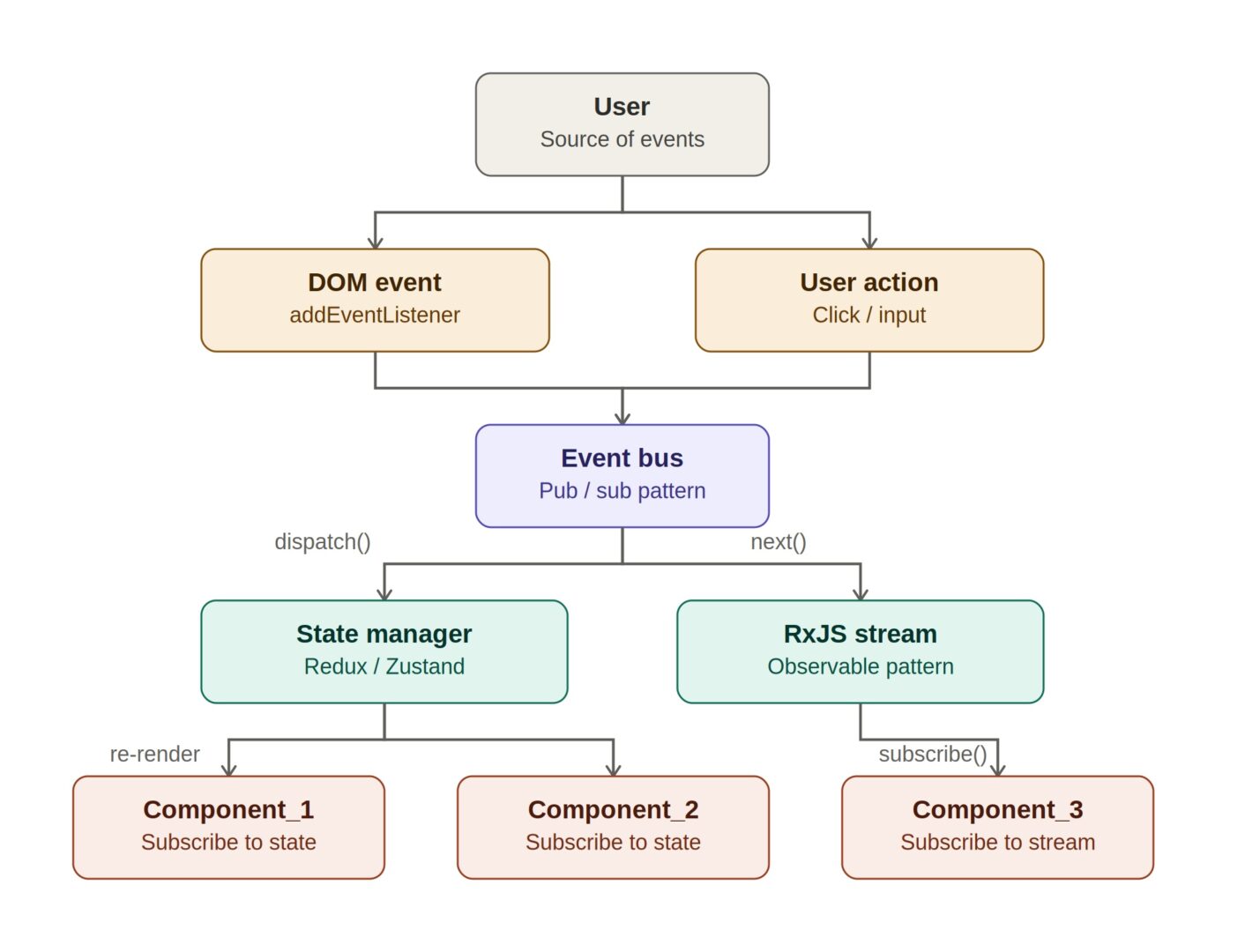
► Events, publishers, and subscribers
Understanding the pattern and each building block is a must. At the core for the pattern we have a decoupled communication model where:
- Publishers (emitters) produce events when something happens, but they don’t care who’s listening
- Events are named signals, imutable facts that carry a payload that describes what happened
- Subscribers (listeners/handlers) react to events they’ve subscribed to – but similar to publishers they don’t care who fired them
► The event bus
The bus is the broker sitting between publishers and subscribers. It maintains a registry of { eventName → [handlers] } and routes emitted events to matching handlers. The three operations are simple: on to register, emit to publish, off to unsubscribe.
One critical property: the bus has no memory. If nobody is subscribed when an event fires, it’s gone.
► Sync and async handling
By default, emit is synchronous – it blocks the call stack until all handlers finish. For lightweight UI updates this is fine. For heavier work, wrapping handlers in Promise.resolve().then(handler) or setTimeout defers them off the main thread, keeping the UI responsive.
► Event naming and shape
Consistent event naming prevents the bus from becoming a maintenance problem. Name events in past tense, cart:item-added, not add-cart-item – they describe facts, not commands.
Use namespace prefixes to group by domain. Keep payloads flat and explicit and avoid passing raw DOM elements or mutable references.
Event-Driven vs Traditional
At its core, EDA is a loosely-coupled, asynchronous, and message-driven architecture that focuses on the flow of events rather than the flow of control. So one comes to wonder is there any case left for traditional architecture?
► When traditional request-response is sufficient?
It turns out that request response still has its uses and wins out when:
- Interaction is inherently sequential – a form submission, a login flow, a checkout. The user does X, expects Y back. There’s no benefit to decoupling that.
- The data model is simple and synchronous – a blog, a settings page, a CRUD dashboard with no real-time requirements
- Team size is small – the coordination overhead of an event bus costs more than it saves when two developers share the whole codebase. Always keep costs in mind.
- Debugging needs to be straightforward – a call stack trace is far easier to follow than an event chain
So, the reality is that most don’t need EDA and that is not a bad thing. At the end of the day it is an informed logical decision that needs to make sense in the context of the project and that brings value than overhead and costs.
► When event-driven provides clear value?
Ok, but when does this added value come into play, if most apps actually don’t need EDA. Well the cases are:
- Real-time collaboration (think about something like a Google Docs) where multiple sources (e.g. users) are mutating shared state simultaneously. This is where the traditional architecture falls apart.
- Making use of microfrontend architecture (independently deployed UI modules) that must communicate without knowing about each other. In this case an event bus feels natural.
- Complex, cross-cutting uis where users add item/s to cart, recommendation engine triggers, analytics fires, stock check runs. Wiring this imperatively becomes a maintenance nightmare.
- WebSocket driven uis where server pushes data unpredictably, then the UI must react, not poll.
- Or plugin/extension systems, when third-party code needs to hook into an app without coupling to the internals
► Can we find the middle ground (hybrid approach)?
The hybrid approach is most of the times the most practical and useful approach. Almost no real production app is purely one or the other. Try to put things into two “baskets”:
- Use request-response for commands (user-initiated actions that expect a direct result)
- Use events for side-effects and reactions (what else happens as a consequence)
A concrete example always helps so, let’s think about a payment form:
- The user submits the form
- An API call is made
- The response is send back from the server
But after the payment succeeds, there are other “side effects” that need to occur so:
- We/the system fires a payment:completed event
- That triggers an email confirmation
- Triggers updates to a dashboard widget
- Triggers a clear of the cart
- Triggers writing to logs
That’s event-driven and this is the balance. Neither pattern fights the other but each does what it does best and we build a solid system and provide value and stability to a customer base.
► Migration strategies (evolving from traditional to event-driven incrementally)
So, the current app is not meeting customer expectations (this could be because the traditional architecture has reached a point of stagnation and new feature requires us to break out and evolve).
Since the app has been in development for some time, migration is not something we do overnight and we need a strategy or a plan. At the very least we must:
- Think about the Strangler fig pattern where we don’t rewrite we wrap. We introduce an event bus alongside existing direct calls, so the new features use events and the old code stays untouched until you’re ready to migrate it.
- Start at the seams where we start with cross-cutting concerns: analytics, notifications, logging. They’re already side-effecty, and decoupling them via events has low risk.
- Event-ify one domain at a time like cart logic, user session, and then inventory. Each gives you confidence before you expand.
To be honest synchronous, tightly coupled code is easier to test in the short term, and when changed it is a given that the regression risk is huge.
On top of that the migration pays off later, not immediately, which might also give rise to questions of why are we doing this hugely impactful change. It is our duty to bring valid reasons and provide tangible proof or ROI.
Tooling
The frontend EDA ecosystem has matured significantly, and the right tool depends heavily on the scale and nature of your application.
- Native DOM Events are the most underrated starting point. The browser’s built-in addEventListener / dispatchEvent with CustomEvent is zero-dependency, universally supported, and sufficient for many intra-component communication needs. If your use case is simple, start here before reaching for a library.
- Custom EventEmitter / Pub-Sub is the next step up. A hand-rolled event bus is typically under 30 lines of JavaScript and gives you full control over the on, emit, and off API. Libraries like mitt (200 bytes) and EventEmitter3 occupy this space — lightweight, framework-agnostic, and easy to reason about. They are the right choice when you want EDA without committing to a larger state management ecosystem.
- Redux remains the canonical choice for large React applications that need both event-driven state updates and a full audit trail. Its actions-and-reducers model is a direct implementation of the command/event distinction: actions describe what happened, reducers describe how state changes in response. The Redux DevTools, with time-travel debugging and action replay, partially address the observability problem inherent in EDA. The cost is verbosity and a steep learning curve for newcomers.
The list could go on but the most common mistake in tooling selection is over-engineering early. A mitt bus is the right tool far more often than RxJS (not specified in the list above).
The best thing we could do is reach for complexity only when the simpler tool demonstrably fails.
Potential Problems
Nothing in life is free. EDA trades one set of problems for another, and being clear-eyed about that trade is what separates a good architectural decision from a fashionable one.
Debugging complexity is the most immediate pain point. In a traditional call stack, you can trace exactly which function called which. In an event-driven system, the chain of causation is fragmented across emitters and handlers that have no direct reference to each other. When something breaks, the question “what fired this event?” can be surprisingly hard to answer. Without deliberate tooling investment — custom logging middleware, event tracing, or DevTools integration — debugging becomes an exercise in reading logs and educated guessing.
And debugging is not the only problem:
- Event flow visibility is a structural version of the same problem. A developer new to the codebase cannot simply read the code to understand what happens when a user clicks a button.
- Race conditions emerge naturally in async event systems. Two events fired in rapid succession may have handlers that both read and write shared state, producing results that depend on timing rather than logic.
- Memory management is a silent cost. Every on() call that is never matched by an off() is a memory leak waiting to accumulate.
- Event storms occur when a single triggering event causes a cascade of subsequent events, each of which triggers further events
- Testing strategies require deliberate rethinking.
- Maintaining event contracts is the long-term cost that compounds most severely
All of this translate to a potential sharp increase in costs.
Potential Added Value
Against those potential problems, the genuine benefits are substantial, but… and there is a big but… when the context is right (we as developers must learn to identify the context).
Decoupling is the core value proposition and the most durable one. Components that communicate through events rather than direct references can be developed, tested, deployed, and replaced independently. That means that two teams can own two components that interact heavily without ever touching each other’s code.
Scalability in the frontend sense means the ability to add new behavior to the system without modifying existing code. When a new feature needs to react to an existing event, a new analytics handler, a new notification trigger, it registers a subscriber and nothing else changes. This is the open/closed principle expressed architecturally, and it is genuinely powerful in large applications with many contributing teams.
Flexibility manifests as adaptability over time. An event-driven system can absorb new requirements — new subscribers, new event types, new routing logic — without major surgery on existing code. Traditional tightly-coupled systems tend to become rigid as they grow, because every new requirement requires touching existing logic. EDA shifts that curve, making the system easier, not harder, to extend as it matures.
Human
and
AI Costs
A dimension that is rarely discussed honestly is the ongoing human cost of designing and maintaining an event-driven system and the increasingly use AI-assisted development.
Design cost is front-loaded. Getting the event taxonomy right, the naming conventions, the domain boundaries, the payload contracts, requires upfront architectural thinking that request-response systems largely defer.
Poor early decisions compound: an event named inconsistently, a payload designed sloppily, a domain boundary drawn wrongly will be inherited by every feature built on top of it.
Maintenance cost is distributed and often invisible.
AI-assisted development introduces a specific irony here. Large language models are highly effective at generating code for request-response patterns (the linearity of a function call maps well to how LLMs reason sequentially).
Event-driven code is structurally harder for AI tools to reason about correctly, because the consequences of an event are scattered across the codebase and context windows.
The practical implication is that EDA raises the floor on documentation quality and team communication. Teams that lack that discipline will find that EDA multiplies their coordination problems rather than solving them.
Conclusions
The honest answer depends on a question most architectural discussions avoid: What is the actual complexity profile of your application?
EDA earns its keep when you have multiple independent components reacting to shared events, real-time data arriving from external sources, a team structure where independent development velocity matters, or a system designed to be extended by code you do not control.
Request-response architecture has survived decades of frontend evolution for good reasons. It is transparent, traceable, and easy to teach. Its failure modes are obvious such that a failed request surfaces immediately, at a specific line of code, with a specific error. Its mental model maps naturally to how developers learn to write code: cause precedes effect, and both are visible in the same place.
So, what ever you end up choosing make sure you understand the business needs, map those to the appropriate architecture and always keep on top of the minor things.
Happy codding!
Îndemnul nostru
Efortul pus în programele pentru studenți completează teoria din facultate cu practica care “ne omoară”. Profitați de ocazie, participând la cât mai multe evenimente!
În cei 3 ani am lucrat la proiecte diverse ce au contribuit decisiv la evoluția mea profesională. Am colaborat strâns cu echipe remarcabile, a căror dedicare și sprijin au fost fundamentale în buna dezvoltare a lucrurilor. Cu fiecare proiect, am învățat nu doar aspecte tehnice, ci și abilități esențiale de comunicare și colaborare, reflectate în experiența mea privind interacțiunile cu clienți și modul în care o echipă eficientă operează. Aceasta este cultura companiei, de la ritmul uneori alert al zilei de lucru și practicile Agile, până la momentele relaxante de socializare cu colegii în pauzele de cafea și activități recreative precum darts și ping pong.

Am făcut cunoștință cu echipa NetRom prin intermediul programelor Internship și NetRom Software Academy, in care am descoperit că noțiunile învățate acasă au totuși aplicabilitate, chiar în cadrul unor aplicații reale. Acele experentie m-au convins să aplic pentru un job.
Mentorii foarte deschiși și colegii cu experiență care mi-au răspuns prompt la toate neclaritățile au transformat provocările în task-uri rezolvate cu succes împreună. Făcând parte din #teamnetrom mi-am depășit frica de a greși și am evoluat într-un mod echilibrat pentru mine.

Am aflat de programele NetRom de la o prezentare organizată în facultate de companie. Am decis să mă înscriu la Summer Camp din dorința de a înțelege ce anume ar presupune o cariera în IT. În urma acestui stagiu de practică, am reușit să dezvolt propria aplicație cu ajutorul mentorilor care mi-au oferit informații teoretice, dar mai ales practice, pe care nu aș fi putut sa le găsesc într-un tutorial aleatoriu de pe internet. Modul meu de abordare a aplicaților s-a schimbat odată ce am înțeles în ce constă mai exact procesul, ce presupune un mediu real de lucru și importanța muncii în echipă.

NetRom Software Testing Academy a fost punctul de plecare pentru o carieră pentru mine. Pe parcursul sesiunilor am avut oportunitatea să cunosc bazele necesare pentru asigurarea calității unui produs, urmate de o zi în companie unde am văzut teoria pusă în practică.
Recomand tuturor celor care își doresc o carieră în QA să ia în considerare această academie, fiind destinată atât celor din domeniu, dar nu numai.

Am descoperit NetRom prin intermediul unui program de internship și am fost impresionată încă de la început de mediul de lucru plăcut, de susținerea și angajamentul colegilor. A fost o oportunitate deosebită de a lucra într-o echipă de proiect, cu roluri specifice, și de a înțelege mai bine cultura companiei. Întreaga perioadă s-a dovedit o experiență valoroasă, atât din punct de vedere al cunoștințelor acumulate, cât și prin prisma relațiilor dezvoltate. În momentul în care mi s-a propus să continui ca angajat permanent, a fost o decizie ușor de luat, bucuroasă fiind să pot aplica cele învățate, dar și să adaug cunoștințe noi în fiecare zi.
