

March 19, 2026 ⏱️ 6 min
By Andreea S. (RnD – WebFrontend Group)
For years, web applications are no longer defined only by how well they perform on a stable network connection.
People work on trains, elevators, factory floors, and other places where connectivity is unstable or unavailable. In today’s cloud-based world, applications constantly interact with services, distributed systems, and enterprise platforms. Under these conditions, traditional web applications fail fast: user actions block, requests time out, integrations break, and work is lost.
In this article, we explore offline-first web applications and why they are not just another web trend.
What is Offline-First
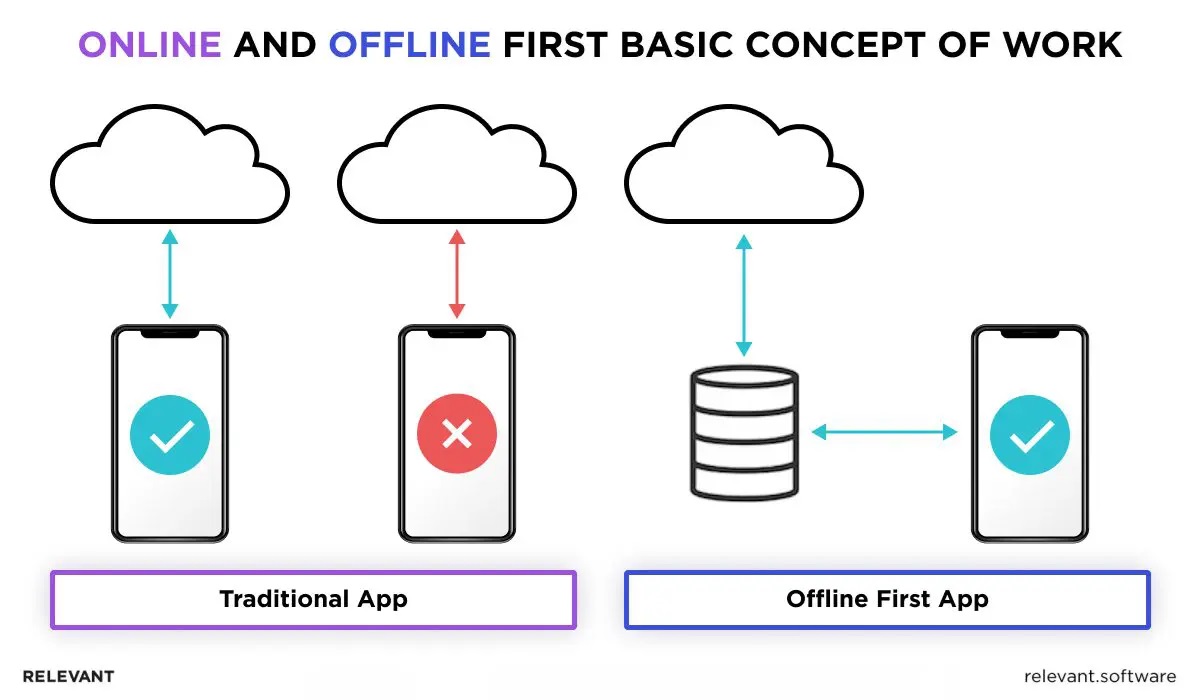
Imagine you’re on a train, making an order. There is no Wi-Fi and the connection is starting to be unstable. The train enters a tunnel and suddenly, you’re offline. Usually, this is where the user experience starts to fall apart. A spinner appears, then an error message, then the application freezes, and when the signal is back, you realize you must start over.
Now imagine the same scenario, but with a happy ending. The train enters the tunnel, and everything works. There is no spinner, no error message, but instead a confirmation page. When the connection comes back, everything is already in place.
This is where the offline-first capabilities come into play. It reverses the traditional thinking, starting with the following assumptions:
- The network is always unreliable.
- Cache what you can.
- Respond immediately to user actions (even if the server response is delayed).
- Synchronize data in background, when possible, but without interrupting the user.
At the same time, modern web applications rarely exist on their own. They interact with cloud databases, microservices, third-party APIs, and much more. Because of this, offline-first design cannot be stopped at the UI layer. It must ensure that locally stored changes can be safely synchronized with cloud services once connectivity is restored, keeping the application in sync with the cloud ecosystem.
Why Is It Important
Offline-first design is not only about serving users without internet access—it is about resilience. Even today, around 2.2 billion people worldwide remain offline, and millions more experience frequent connectivity drops due to network instability or expensive data plans.
Designing web applications to work offline ensures users can work without interruptions – viewing content, saving data, improving both accessibility and user experience even when the connection is unstable. Moreover, offline-capable applications can minimize unnecessary network requests, creating applications that are more responsive to failures.
In cloud-based architecture, this also reduces loads on backend services. With caching and background synchronization strategies, applications generate fewer redundant requests, reducing infrastructure costs while improving traffic management across cloud services.
PWAs and Offline-First
In practice, offline-first capabilities on the web are possible by Progressive Web App (PWA). PWAs do not reinvent the wheel, but instead they give developers more control over caching, request handling, and background synchronization—capabilities required to make offline-first applications viable.
What makes PWAs powerful is the additional layer they introduce between the application and the network – primarily through Service Workers. Rather than sending every request directly to a server, this layer can control how requests are handled, what data is stored locally, and how synchronization occurs over time. Although PWAs run in the browser, they offer many capabilities associated with native applications:
- They can be installed on the device’s home screen
- Can work without active internet connection, when offline caching and sync strategies are implemented.
- Persist user actions locally instead of waiting for server confirmation.
- Background synchronization ensures changes are automatically synced when connectivity is restored, without interrupting the users.
- PWAs can access native features, such as push notifications and camera access.
- Update the UI optimistically when the server response is delayed.
- Apply background updates, ensuring the latest version is always used without users being forced to manually download updates.
In cloud-connected systems, this pattern is commonly used in architecture based on REST or GraphQL APIs, microservices, event-driven systems, or serverless backends.
Offline-First In The Cloud
While PWAs enable offline capabilities in the browser, modern applications often rely on cloud-based architecture. Many of them depend on a range of cloud services, such as APIs, microservices, authentication providers, and even business workflows. Therefore, when the connection is lost, the user experience should not collapse.
In cloud-oriented architecture, an offline-first design decouples the client from cloud services. Rather than waiting for user actions to be confirmed by an API, the user actions are stored locally and later synchronized with cloud systems once the connectivity is restored.
This model fits naturally with distributed cloud systems, for example:
- API gateways can act as an entry point that receives synchronized requests once connectivity is restored.
- Serverless functions can process these requests in the background and trigger business logic on demand.
- Event streams allow changes to be distributed across multiple services in an asynchronous manner.
- Message queues allow requests to be buffered and processed asynchronously, when the network is temporarily unavailable.
As a result, they continue to operate locally while remaining aligned with cloud services once connectivity returns.
Offline-First In Frontends
While PWAs provide the browser-level capabilities required for offline-first behavior, frontend frameworks determine how data and state management are implemented in practice. Regardless of the framework (e.g. React, Vue, or Angular), these applications follow the same core principles:
- A local-first data model
- Asynchronous background synchronization
- UI decoupled from network availability
- Explicit state management
Below is an overview of offline-first implementation patterns in popular frontend frameworks.
React – Offline-First Through Data Layers
React does not provide an offline-first architecture by default. All decisions end up with the developers, as the ecosystem has filled the gap by treating offline first as a data-layer responsibility. Instead of adding offline logic inside components, it is implemented through hooks, adapters, and data services.
In this approach, components render from locally persisted state, while network requests and synchronization occur asynchronously in the background. Changes are applied using an optimistic approach and synchronized with the server later, once a response is available.
Vue – Offline-First as Reactive Continuity
Vue’s reactivity system fits naturally to offline-first architectures, automatically keeping the UI in sync, no matter if changes come from local user actions or background sync processes.
A common example of an offline-first Vue architecture includes a reactive local store, a background synchronization process that updates the persisted state and a set of computed properties that adapt the UI to stale or partially synchronized data.
Angular – Offline-First as Architecture
Angular approaches offline first as an architectural decision rather than a UI feature. Data persistence and synchronization are usually encapsulated within services, enforcing a clear separation of responsibilities. In practice, whether data comes from local storage or a remote API, components subscribe to observables ensuring consistent UI behavior regardless of network availability.
Limitations
While offline-first brings significant improvements in resilience and user experience, they also introduce several limitations such as:
- Data synchronization complexity – since changes must be synchronized with backend APIs once the network is available, implementing these strategies can significantly increase system complexity.
- Offline storage limitations: Offline data storage is usually used in technologies such as IndexedDB or browser storage. These options come with size limits and may not be suitable for applications that require large or long-lived offline datasets.
- Conflict resolution – When multiple users modify the same data while offline, conflicts may occur during synchronization.
- Platform limitations: In web-based implementations, offline capabilities depend on browser support and available web APIs. Differences between browsers or platforms may lead to inconsistent behavior.
Despite these challenges, good architectural design and appropriate synchronization strategies can help reduce many of these limitations and enable reliable offline-first experiences.
Conclusions
For front-end teams, offline-first is no longer a nice-to-have feature; it is becoming a core architectural principle. In today’s cloud-based environments, the challenge is no longer whether web applications can support offline behavior, but whether they are intentionally designed to remain reliable while continuing to integrate with cloud services, APIs, and enterprise systems. By assuming the network cannot be trusted, teams build applications that are more resilient, more inclusive, and ultimately more trustworthy from the user’s perspective.
While PWAs provides the technical foundation needed to implement this approach on the web, the frontend frameworks define how offline-first principles are used within an application, while cloud services ensure data synchronization and integration with backend systems. Although web applications still have some limitations compared to native applications, they are fully capable of delivering mobile experiences through the browser, making them viable for a wide range of business scenarios.
As connectivity remains unpredictable for many users even today, offline-first is no longer only about supporting moments without internet access. It’s about building applications that function reliably in the real world while still participating in a cloud-connected ecosystem. In that sense, offline first is not a fallback strategy, but a practical design approach for modern web systems.
Îndemnul nostru
Efortul pus în programele pentru studenți completează teoria din facultate cu practica care “ne omoară”. Profitați de ocazie, participând la cât mai multe evenimente!
În cei 3 ani am lucrat la proiecte diverse ce au contribuit decisiv la evoluția mea profesională. Am colaborat strâns cu echipe remarcabile, a căror dedicare și sprijin au fost fundamentale în buna dezvoltare a lucrurilor. Cu fiecare proiect, am învățat nu doar aspecte tehnice, ci și abilități esențiale de comunicare și colaborare, reflectate în experiența mea privind interacțiunile cu clienți și modul în care o echipă eficientă operează. Aceasta este cultura companiei, de la ritmul uneori alert al zilei de lucru și practicile Agile, până la momentele relaxante de socializare cu colegii în pauzele de cafea și activități recreative precum darts și ping pong.

Am făcut cunoștință cu echipa NetRom prin intermediul programelor Internship și NetRom Software Academy, in care am descoperit că noțiunile învățate acasă au totuși aplicabilitate, chiar în cadrul unor aplicații reale. Acele experentie m-au convins să aplic pentru un job.
Mentorii foarte deschiși și colegii cu experiență care mi-au răspuns prompt la toate neclaritățile au transformat provocările în task-uri rezolvate cu succes împreună. Făcând parte din #teamnetrom mi-am depășit frica de a greși și am evoluat într-un mod echilibrat pentru mine.

Am aflat de programele NetRom de la o prezentare organizată în facultate de companie. Am decis să mă înscriu la Summer Camp din dorința de a înțelege ce anume ar presupune o cariera în IT. În urma acestui stagiu de practică, am reușit să dezvolt propria aplicație cu ajutorul mentorilor care mi-au oferit informații teoretice, dar mai ales practice, pe care nu aș fi putut sa le găsesc într-un tutorial aleatoriu de pe internet. Modul meu de abordare a aplicaților s-a schimbat odată ce am înțeles în ce constă mai exact procesul, ce presupune un mediu real de lucru și importanța muncii în echipă.

NetRom Software Testing Academy a fost punctul de plecare pentru o carieră pentru mine. Pe parcursul sesiunilor am avut oportunitatea să cunosc bazele necesare pentru asigurarea calității unui produs, urmate de o zi în companie unde am văzut teoria pusă în practică.
Recomand tuturor celor care își doresc o carieră în QA să ia în considerare această academie, fiind destinată atât celor din domeniu, dar nu numai.

Am descoperit NetRom prin intermediul unui program de internship și am fost impresionată încă de la început de mediul de lucru plăcut, de susținerea și angajamentul colegilor. A fost o oportunitate deosebită de a lucra într-o echipă de proiect, cu roluri specifice, și de a înțelege mai bine cultura companiei. Întreaga perioadă s-a dovedit o experiență valoroasă, atât din punct de vedere al cunoștințelor acumulate, cât și prin prisma relațiilor dezvoltate. În momentul în care mi s-a propus să continui ca angajat permanent, a fost o decizie ușor de luat, bucuroasă fiind să pot aplica cele învățate, dar și să adaug cunoștințe noi în fiecare zi.
