
June 23, 2026 ⏱️ 6 min
By David Z. (QA – Process Design Group)
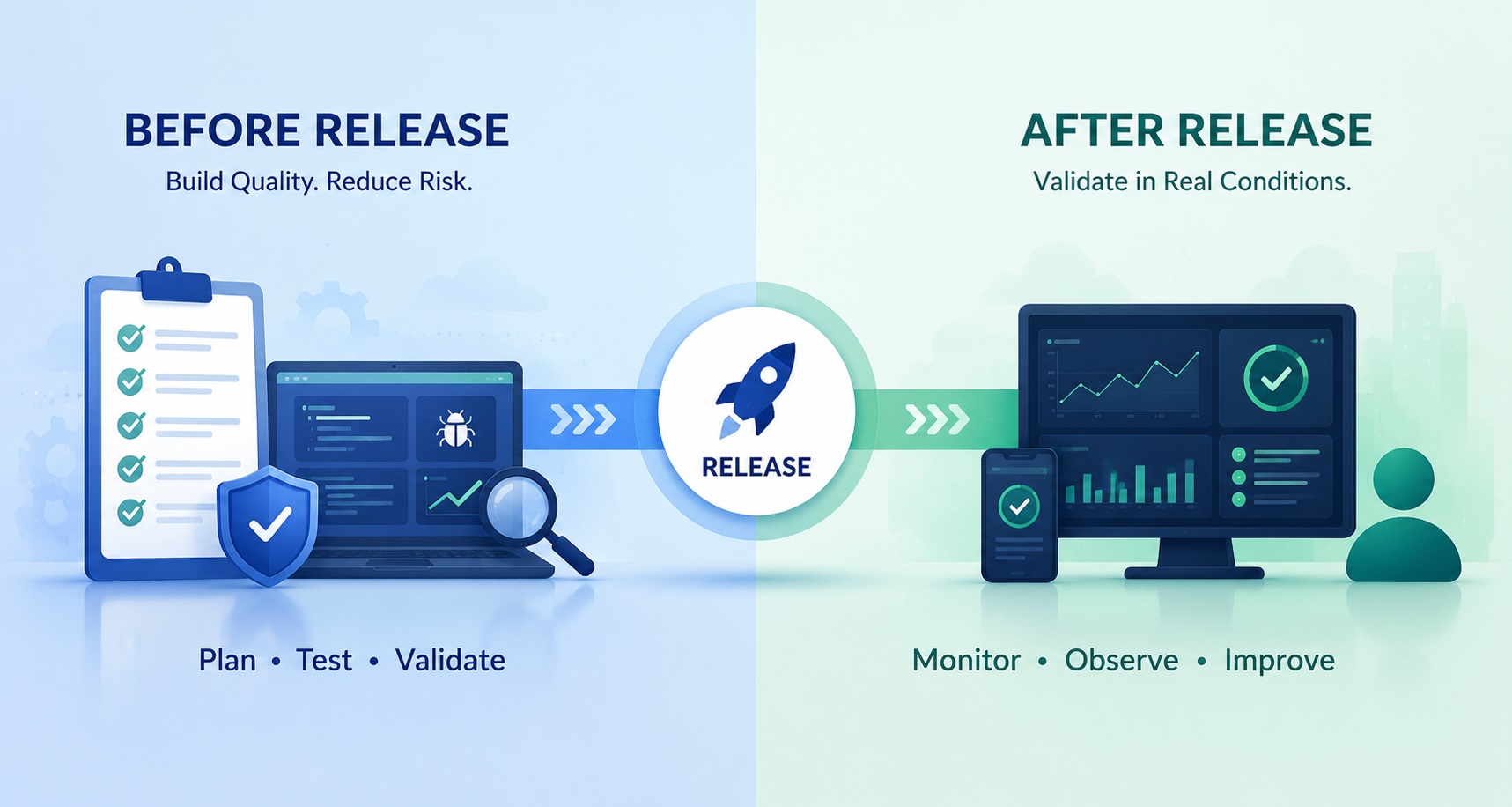
Software quality does not start at deployment or end once a version is live. It is built before release and validated again in production.
This is a continuous effort. Before release, the goal is to reduce uncertainty. After release, the goal is to confirm that the application behaves as expected under real-world conditions.
In this article, we explore how quality is shaped throughout the release lifecycle and how pre- and post-release activities work together to create a reliable and predictable delivery process.
Before Release
Pre-release activities exist to make a release predictable, safe, and aligned with business expectations. The teams focus on:
- Scope and impact: defining the release scope, understanding impact
- Test preparation: planning testing, managing defects
- Release readiness: preparing environments, making the go/no-go decision
The first step is scope clarity. A release should have a clear version, a documented list of included changes, and agreement that nothing new is added unless the team makes that decision on purpose. When scope is unclear, testing becomes reactive and the release decision becomes much harder to trust.
The next step is risk and impact assessment. The team should understand which components are directly affected, which critical workflows might be impacted indirectly, whether external integrations or configurations are changing, and whether any data migrations or structural changes are involved.
QA helps translate scope and technical change into a practical test strategy, with the right mix of regression, sanity, and smoke validations.
Readiness Is More Than Test Execution
A mature pre-release process goes beyond running tests. It also includes:
- defect management
- environment readiness
- configuration checks
- release communication
Defects found during pre-release should be recorded, prioritized, and discussed in terms of release impact. Before deployment starts, the team should know which issues were fixed and retested, which known issues remain open, and what level of risk is being accepted.
Environment preparation is another area that is easy to underestimate. Final validation should happen in an environment as close as possible to production, with the right configurations, feature flags, and dependencies in place. If the release includes migration steps or database changes, those should be reviewed, tested, and backed by rollback or failure-handling plans.
Observability needs to be prepared before deployment. Without logs, metrics, and alerts already in place, the team enters production without enough visibility to understand issues or system behavior.
That means slower investigation, weaker release confidence, and more pressure after deployment.
The Release Decision
One of the most important moments in the release flow is the go / no-go decision. That decision should not be improvised, and it should not depend only on time pressure. It should be based on test results, known defects, environment readiness, risk, and business priorities.
This matters because no testing process can prove that a release is defect-free. The goal is not perfection, but is to make risks visible, understood, and acceptable before production.
A simple example makes the difference clear. The team may finish regression with mostly positive results, but if a configuration change is still uncertain or a migration step has not been properly tested, the release is not truly ready. A release with a few accepted known issues can still be safer than one that looks clean on paper but lacks clear scope and proper environment preparation.
After Release
Once deployment is complete, the focus changes. The team is no longer preparing the release but is now checking how the system behaves in the only environment that truly matters: production.
Production exposes the application to real traffic, real users, real integrations, and real conditions. Lower environments can simulate many things, but they cannot fully reproduce live behavior. That is why post-release testing should be treated as a structured validation phase.
This does not mean reckless testing in production. It relies on safe observation, telemetry, and controlled checks. The team reviews system health, logs, runtime errors, failed requests, background processing, and critical workflows while keeping direct production interaction limited and low-risk.
Production Tells the Truth
One of the strongest ideas in post-release is that production provides two forms of truth: real user experience and real application behavior. It shows how users navigate the product, whether they complete important flows successfully, whether the system remains stable over time, and where retries, slowdowns, or failures begin to appear.
A release should not be considered healthy just because the application opens successfully. A healthy release is one where runtime behavior remains under control. Logs are especially useful here because they provide immediate technical visibility without changing live data. They can reveal repeated failures, new exceptions, and issues affecting critical workflows or multiple users even when the application still looks fine on the surface.
Some of the most important production issues happen outside the visible UI. Background jobs, queues, scheduled processes, integrations, and asynchronous flows can fail quietly if the team only checks the front end.
Observability and User Behavior
A strong post-release process usually follows a timeline. In the first minutes after deployment, the team checks whether the application is accessible, critical services are running, monitoring is active, and startup logs do not show severe problems. In the next stage, the focus shifts to early runtime issues such as exceptions, failed requests, unusual restarts, and background activities.
Later, the release is validated through real usage. That is where observability becomes critical. Real user monitoring, frontend error tracking, logs, infrastructure metrics, workflow analytics, and support feedback help the team understand whether the release is stable under normal conditions.
Users also validate the system in ways structured testing cannot fully predict. They use real data, combine features in unexpected ways, create concurrency, and reveal which workflows matter most in actual work. The team’s job is to turn this data into evidence: what users are trying to do, where they succeed, and where they struggle.
One Quality Process
Pre-release and post-release are not separate worlds. They are two connected parts of the same quality process. Pre-release work reduces uncertainty before deployment, while post-release confirms whether reality matches expectations once the version is live.
The connection between them is direct. If scope is clear, risk is understood, regression is focused, environments are prepared, and observability is ready before deployment, then post-release follow-up becomes much faster and safer. In practice, the quality of the post-release phase is often decided long before the release starts.
QA plays an important role in both phases. Before release, QA helps define what should be tested, where deeper validation is needed, and what risks should be highlighted. After release, QA helps interpret production signals and turn them into a clear quality view for the team.
Final Thought
A strong release process should always answer two questions. Are we ready to deploy, and does the system behave as expected once it is live?
The first answer comes from pre-release discipline. The second comes from post-release evidence.
When teams take both seriously, quality becomes a release discipline built on preparation, visibility, and informed decisions. That is what makes releases safer and easier to trust.
Îndemnul nostru
Efortul pus în programele pentru studenți completează teoria din facultate cu practica care “ne omoară”. Profitați de ocazie, participând la cât mai multe evenimente!
În cei 3 ani am lucrat la proiecte diverse ce au contribuit decisiv la evoluția mea profesională. Am colaborat strâns cu echipe remarcabile, a căror dedicare și sprijin au fost fundamentale în buna dezvoltare a lucrurilor. Cu fiecare proiect, am învățat nu doar aspecte tehnice, ci și abilități esențiale de comunicare și colaborare, reflectate în experiența mea privind interacțiunile cu clienți și modul în care o echipă eficientă operează. Aceasta este cultura companiei, de la ritmul uneori alert al zilei de lucru și practicile Agile, până la momentele relaxante de socializare cu colegii în pauzele de cafea și activități recreative precum darts și ping pong.

Am făcut cunoștință cu echipa NetRom prin intermediul programelor Internship și NetRom Software Academy, in care am descoperit că noțiunile învățate acasă au totuși aplicabilitate, chiar în cadrul unor aplicații reale. Acele experentie m-au convins să aplic pentru un job.
Mentorii foarte deschiși și colegii cu experiență care mi-au răspuns prompt la toate neclaritățile au transformat provocările în task-uri rezolvate cu succes împreună. Făcând parte din #teamnetrom mi-am depășit frica de a greși și am evoluat într-un mod echilibrat pentru mine.

Am aflat de programele NetRom de la o prezentare organizată în facultate de companie. Am decis să mă înscriu la Summer Camp din dorința de a înțelege ce anume ar presupune o cariera în IT. În urma acestui stagiu de practică, am reușit să dezvolt propria aplicație cu ajutorul mentorilor care mi-au oferit informații teoretice, dar mai ales practice, pe care nu aș fi putut sa le găsesc într-un tutorial aleatoriu de pe internet. Modul meu de abordare a aplicaților s-a schimbat odată ce am înțeles în ce constă mai exact procesul, ce presupune un mediu real de lucru și importanța muncii în echipă.

NetRom Software Testing Academy a fost punctul de plecare pentru o carieră pentru mine. Pe parcursul sesiunilor am avut oportunitatea să cunosc bazele necesare pentru asigurarea calității unui produs, urmate de o zi în companie unde am văzut teoria pusă în practică.
Recomand tuturor celor care își doresc o carieră în QA să ia în considerare această academie, fiind destinată atât celor din domeniu, dar nu numai.

Am descoperit NetRom prin intermediul unui program de internship și am fost impresionată încă de la început de mediul de lucru plăcut, de susținerea și angajamentul colegilor. A fost o oportunitate deosebită de a lucra într-o echipă de proiect, cu roluri specifice, și de a înțelege mai bine cultura companiei. Întreaga perioadă s-a dovedit o experiență valoroasă, atât din punct de vedere al cunoștințelor acumulate, cât și prin prisma relațiilor dezvoltate. În momentul în care mi s-a propus să continui ca angajat permanent, a fost o decizie ușor de luat, bucuroasă fiind să pot aplica cele învățate, dar și să adaug cunoștințe noi în fiecare zi.
